
Key Takeaways
- A hospital bill can arrive before Medisave and MediShield Life have been fully processed. The gap between what insurance pays and what the hospital charges is real, and it is growing.
- A personal loan from a licensed moneylender has no restriction on use. You receive the cash and pay the hospital directly.
- From April 2026, new Integrated Shield Plan riders can no longer cover the MediShield Life deductible. More Singaporeans will now face a larger out-of-pocket gap after hospitalisation.
- MediShield Life has an annual deductible of $1,500 to $4,500 depending on your age and ward class. That amount must be paid before insurance coverage applies.
- You can borrow up to 6 times your monthly income if your annual income is $20,000 or above. If your income is below $20,000, the cap is $3,000.
- Interest on a personal loan from a licensed moneylender is capped at 4% per month by MinLaw. Total charges cannot exceed the original amount you borrowed.
- Every licensed moneylender must have you sign the loan contract in person at their registered office. No exceptions.
- EZ Pte Ltd is listed on the MinLaw Registry of Moneylenders, License No. 20/2026. Verify at rom.mlaw.gov.sg before you visit.
The bill is on the table. Your family member was just discharged. The hospital wants payment, and your Medisave did not cover everything.
This is more common than most families will admit. Healthcare costs in Singapore have been rising steadily, and not every household has savings set aside for the gap between what MediShield Life pays and what the hospital actually charges. A personal loan from a licensed moneylender is one legal, regulated way to close that gap fast.
This guide tells you exactly how it works, how much you can borrow, what the process looks like step by step, and how to protect yourself from scams when you are already under pressure.
If you are still weighing all your options first, read our guide on what Singapore families can legally do when they cannot pay a hospital bill.
Why Medical Bills Leave a Cash Gap Even With Insurance
MediShield Life is not a full coverage plan. It was designed to cover subsidised treatment in public hospitals at Class B2 and C wards. If your family member stayed in a Class A ward, a B1 ward, or a private hospital, MediShield Life covers only a portion of the total bill.
There is also the deductible to account for. MediShield Life has an annual deductible ranging from $1,500 to $4,500 depending on your age and the ward class your family member stayed in. For most patients under 80 in a Class C ward, the deductible is $2,000. In a Class A ward or private hospital, it rises to $3,500. That amount comes out of your pocket before the insurance payout applies.
Medisave can help. But the withdrawal limits are set. If the bill is large, your Medisave runs out before the hospital does.
The gap has also grown wider from April 2026. Previously, Integrated Shield Plan riders could cover the deductible, meaning some policyholders paid close to nothing out of pocket. New riders sold from 1 April 2026 can no longer cover the deductible. That amount now falls entirely on you, paid via Medisave or cash. If your Medisave runs short, that is the gap a personal loan is built to fill.
The cash gap is what you are left with. It is the deductible, the charges outside the standard plan, and the difference between what insurance paid and what the hospital is owed.
Can You Use a Personal Loan for a Medical Bill?
Yes. A personal loan from a licensed moneylender has no restriction on how you use the funds. You receive the money and use it to pay the hospital, the specialist, the pharmacy, or whatever the bill requires.
This is different from Medisave, which has specific approved uses and withdrawal limits. A personal loan puts the money in your hands directly. You then settle the bill on your own terms.
For borrowers who have already used Medisave and MediShield Life and still face an unpaid balance, a personal loan is one of the fastest legal options available. You can read more about how unsecured personal loans work in Singapore in our our complete guide.
How Much Can You Borrow With a Personal Loan?
MinLaw sets the borrowing limits for all licensed moneylenders in Singapore. These limits apply uniformly across every licensed moneylender you visit. They are not set by individual lenders.
For unsecured personal loans, the caps are as follows:
| Your Annual Income | Maximum Unsecured Loan |
| Below $20,000 | $3,000 |
| $20,000 and above | 6 times your monthly income |
If you earn $2,500 a month, the maximum you can borrow is $15,000. If you earn $1,500 a month, the cap is $3,000.
This limit applies across all licensed moneylenders combined. If you already have an existing personal loan with another licensed moneylender, that outstanding amount counts toward your total cap. The loan officer will check this when they review your application.
What the Personal Loan Application Process Actually Looks Like
A licensed moneylender cannot disburse a personal loan without a face-to-face meeting. MinLaw requires every borrower to sign the loan contract in person at the lender’s registered office. There is no fully remote personal loan in Singapore from a licensed moneylender.
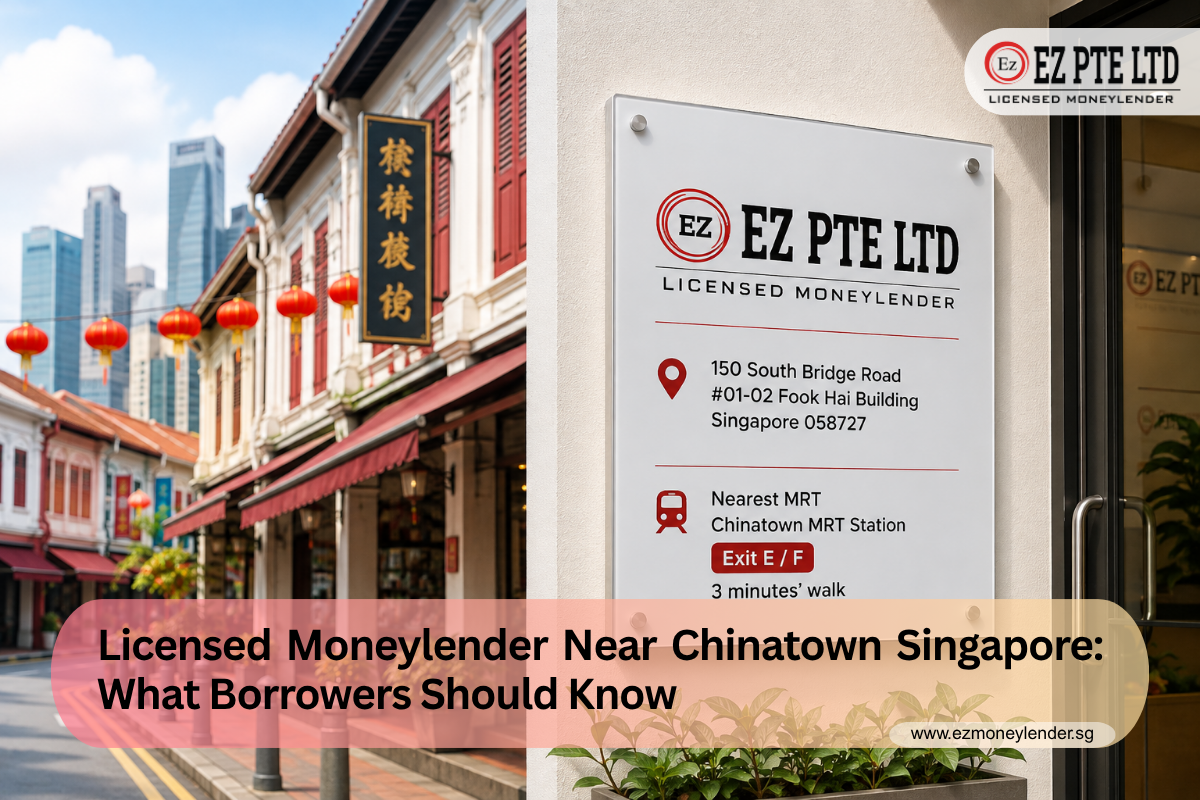
Here is exactly what to expect at EZ Pte Ltd, located at Fook Hai Building in Chinatown:
Step 1. Prepare your documents before you go. You will need your NRIC. You will need proof of income, which can be your last three payslips, your CPF contribution statement, or your income tax notice of assessment. You will also need one document proving your residential address, such as a utility bill, phone bill, or tenancy agreement.
Step 2. Call ahead or walk in. You can reach EZ Pte Ltd at +65 6220 0822 before your visit. Tell them briefly what you need. They will confirm what documents to bring so you do not waste a trip.
Step 3. Receive and review your loan offer. Once your documents are reviewed, you will receive a personal loan offer. This will state the loan amount, the monthly repayment, the interest charged, and any fees. Read it fully. Every licensed moneylender is legally required to explain all terms to you in a language you understand before you sign.
Step 4. Sign the contract at the office. You sign in person. No licensed moneylender will ask you to sign through WhatsApp, email, or via a representative sent to your home. If someone suggests this, they are not licensed.
Step 5. Receive the loan. Disbursement happens after the contract is signed.
A Real Situation: How Ailin Used a Personal Loan to Clear Her Father’s Hospital Bill
Ailin is a 38-year-old accounts executive from Buona Vista. Her 71-year-old father was admitted to Tan Tock Seng Hospital for a hip fracture after a fall at home. The total bill after MediShield Life and Medisave was processed came to $6,100 unpaid.
Ailin’s brothers were in Malaysia and could not transfer funds quickly. She needed to clear the bill before her father could be discharged.
She found EZ Pte Ltd through the MinLaw Registry. She called the same afternoon. She brought her NRIC, her latest payslip, and her CPF statement. She earned $3,400 per month, which meant she could borrow up to $20,400. She applied for $6,500, enough to cover the bill and her father’s first month of follow-up medication.
The loan officer explained every term before Ailin signed. She understood the monthly repayment. She understood the interest. She signed.
Her father was discharged the next morning. The bill was cleared. She did not fall into a scam because she checked the MinLaw Registry first.
Ugly Truth: A Personal Loan Is Not Free Money
You will repay more than you borrow. With interest capped at 4% per month and a late fee of up to $60 per month if you miss a payment, this is a real financial cost.
Borrow $6,500 on a 6-month repayment plan and your total repayment will be more than $6,500. That calculation is yours to do before you sign. One protection worth knowing: MinLaw caps the total charges on any personal loan. Interest, late interest, admin fees, and late fees combined cannot exceed the original amount you borrowed.
The path forward is this: borrow only the amount you actually need. Match the repayment term to what your monthly income can carry. If you earn $3,000 a month, a $500 monthly repayment is manageable. A $1,500 monthly repayment is not.
Take a personal loan to clear the medical emergency. Then build a small buffer, even if it is $100 a month into a separate savings account, so the next unexpected hospital bill does not put you back in the same position.
How to Protect Yourself From Scams During a Medical Emergency
Scammers know you are in a rush. They approach people in exactly this kind of situation.
Do not respond to any moneylender who contacts you by SMS, WhatsApp, or unsolicited phone call. Licensed moneylenders in Singapore are not permitted to solicit loans this way.
Walk away from any lender who:
- Claims to offer a personal loan without seeing your documents
- Asks for your SingPass login credentials
- Requires you to pay a deposit before the loan is given
- Sends someone to your home or workplace to collect your NRIC
- Cannot be found on the MinLaw Registry
EZ Pte Ltd is on that registry. License No. 20/2026. Check it yourself before you visit. This takes two minutes and protects you from every unlicensed lender who targets people in your situation. For a detailed breakdown of the warning signs, see our guide on how the loan approval process works.
The hospital bill is what brought you here. That was the immediate problem.
But what this guide really gives back is something larger. You are not going to a loan shark. You are not guessing. You now know the regulated limit, the legal process, and the exact signs of a scam. You can walk into EZ Pte Ltd at Fook Hai Building in Chinatown and ask every question you have before signing a single document.
The home stays calm. Your family member is recovering. You handled this properly and protected what you spent your whole life building. That is everything.
FAQ
Can I get a personal loan for medical bills if my credit score is low?
Licensed moneylenders do not use the CBS credit report that banks use. They check the Moneylenders Credit Bureau, or MLCB, which tracks your current loan obligations with other licensed moneylenders only. A low CBS score does not automatically disqualify you from a personal loan. What matters is your income, your existing licensed moneylender debt load, and whether you are within the MinLaw borrowing cap. You can read more about how MLCB works in our detailed guide.
How long does the personal loan take to process?
Once your documents are verified at the office and you sign the contract, disbursement happens the same day. The total time depends on how quickly you can gather your documents and travel to Fook Hai Building. There is no fully online disbursement under Singapore regulations. The in-person step is a legal requirement, not a delay.
Can I use Medisave and a personal loan at the same time to pay the hospital?
Yes. There is no rule preventing you from using Medisave, MediShield Life, and a personal loan together to cover the same hospital bill. Most borrowers in medical emergencies use all three. Medisave pays what it is permitted to cover. MediShield Life pays its portion after the deductible. The personal loan covers whatever remains unpaid.
What documents do I need to bring for a medical emergency personal loan?
You need your NRIC or valid work pass, proof of income such as your last three payslips or CPF contribution statement, and one document showing your home address such as a utility bill or tenancy agreement. If you have the hospital bill with you, bring that too. It helps the loan officer understand the exact amount you need.
What is the difference between a licensed moneylender and a loan shark? A licensed moneylender is registered on the MinLaw Registry, subject to a 4% monthly interest cap, and required by law to provide you with a written contract and explain every term before you sign. A loan shark is unlicensed, charges unregulated rates, and uses harassment to collect. The two are not similar in any way. Verify any lender you consider at the Ministry Of Law Registry before engaging them.
You Have What You Need. Take the Next Step.
You know the personal loan limits. You know the process. You know what a scam looks like and how to avoid it.
If there is a hospital bill that needs to be cleared, the next step is straightforward. Call EZ Pte Ltd at +65 6220 0822 or walk in to Fook Hai Building, Chinatown. Bring your NRIC, your income proof, and your address document. You will receive a clear personal loan offer with every term explained before you sign anything.
EZ Pte Ltd is listed on the MinLaw Registry. License No. 20/2026. Verify us before you come in.
It takes courage to ask for help when you are already dealing with a difficult situation. Coming in is the right call. We will walk you through everything.