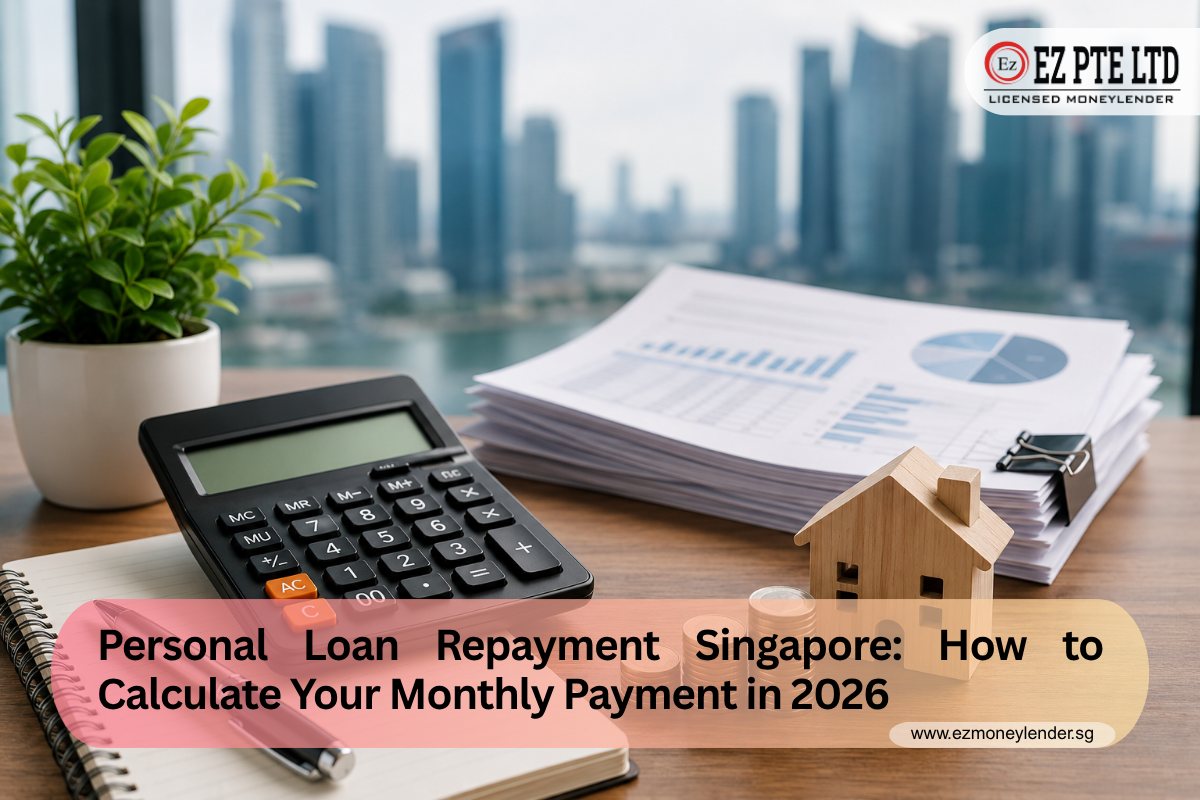
Personal Loan Repayment Singapore: How to Calculate Your Monthly Payment in 2026
Last updated on August 27th, 2026 at 09:34 am
Personal loan repayment Singapore borrowers need to understand goes beyond simply asking, “How much can I borrow?” An equally important question is: How much can I comfortably repay every month?
A loan may help you manage an urgent expense, temporary cash-flow shortage, medical bill, household repair or another unexpected financial need. However, the amount you qualify to borrow and the amount you can realistically afford to repay are not always the same.
Before taking a personal loan in Singapore, it is important to understand how repayments work, what affects your monthly payment and how interest and permitted fees may affect the total amount you pay.
This guide explains personal loan repayments in straightforward terms and provides practical examples to help you make a more informed borrowing decision.
Key Takeaways
- Your monthly loan repayment depends on the amount borrowed, interest, repayment schedule and applicable fees.
- Licensed moneylenders in Singapore are subject to statutory limits on interest and certain fees.
- Being eligible for a particular loan amount does not necessarily mean you should borrow the maximum.
- Always consider your existing expenses and financial commitments before accepting a repayment plan.
- Ask for the complete repayment schedule and understand the loan contract before signing.
What Is a Personal Loan Repayment in Singapore?
A personal loan repayment is the amount you are required to pay according to the repayment schedule stated in your loan contract.
Depending on the agreed terms, repayments may be structured over a specified period. Each payment contributes towards the amount owed under the loan, including the applicable interest.
Your actual repayment schedule will depend on your individual loan agreement.
This is why two borrowers receiving the same loan amount may not necessarily have exactly the same repayment structure.
How Is Personal Loan Repayment Singapore Calculated?
Several factors can affect your personal loan repayment in Singapore.
1. Principal Loan Amount
The principal is the amount you borrow.
For example, if you receive a loan of S$3,000, your starting principal is S$3,000.
Generally, borrowing a larger amount results in a greater repayment obligation.
2. Interest
Interest is the cost charged for borrowing money.
For licensed moneylenders in Singapore, the maximum interest rate that may be charged is regulated by the Ministry of Law.
Interest should therefore be considered when determining whether a repayment schedule is affordable.
3. Repayment Period
The repayment period refers to the period over which the loan is scheduled to be repaid.
The repayment structure can affect how much you need to set aside for each payment.
Rather than choosing a repayment schedule based solely on the lowest immediate payment, consider the entire repayment obligation and whether it is manageable alongside your other expenses.
4. Permitted Fees
Certain fees may apply to a licensed moneylender loan, subject to Singapore’s regulations.
Always review these carefully before accepting a loan.
How Much Interest Can a Licensed Moneylender Charge in Singapore?
Licensed moneylenders operate under rules administered by Singapore’s Ministry of Law.
The maximum interest rate that a licensed moneylender can charge is 4% per month.
If a borrower is late with a repayment, late interest is also capped at 4% per month for each month the repayment is late, and late interest may only be charged on the amount that is overdue.
There are also limits on permitted fees.
For example, an administrative fee charged when a loan is granted cannot exceed 10% of the principal amount.
A late repayment fee cannot exceed S$60 for each month of late repayment.
Importantly, the total charges consisting of interest, late interest, upfront administrative fees and late fees cannot exceed an amount equivalent to the principal originally granted.
Borrowers should still check the exact terms offered to them because these are legal maximums, not a statement that every loan will be charged at the maximum rate.
Personal Loan Repayment Example
Consider a simplified example.
Suppose a borrower requires:
Loan amount: S$3,000
Before accepting the loan, the borrower should not simply ask whether S$3,000 can be approved.
Instead, the borrower should request a clear breakdown showing:
- Principal amount
- Applicable interest rate
- Repayment frequency
- Number of repayments
- Amount of each scheduled repayment
- Administrative fee, if applicable
- Total amount payable
The borrower can then compare the required repayment against monthly disposable income.
Why This Matters
Imagine someone earns S$3,500 per month but already has significant monthly commitments.
These might include:
| Monthly Expense | Example |
|---|---|
| Rent / Housing | S$900 |
| Food | S$600 |
| Transport | S$300 |
| Utilities & Phone | S$200 |
| Family Expenses | S$500 |
| Existing Debt | S$400 |
| Other Expenses | S$300 |
| Total Existing Expenses | S$3,200 |
This leaves only approximately S$300 before considering a new loan repayment.
The example illustrates an important principle:
Income alone does not determine whether a loan is affordable.
Your existing financial commitments matter just as much.
How Much Personal Loan Can You Borrow in Singapore?
Singapore has statutory limits on the total unsecured amount a borrower may borrow across licensed moneylenders.
For Singapore Citizens and Permanent Residents:
| Annual Income | Maximum Unsecured Borrowing |
| Less than S$10,000 | S$3,000 |
| S$10,000 to below S$20,000 | S$3,000 |
| S$20,000 and above | Up to 6 times monthly income |
Different limits apply to foreigners residing in Singapore at lower income levels.
If annual income is at least S$20,000, the maximum unsecured borrowing limit is generally up to six times monthly income.
However, this is a maximum legal borrowing limit across licensed moneylenders, not a guaranteed loan amount.
Actual approval remains subject to assessment.
Maximum Borrowing Does Not Mean Maximum Affordability
This distinction is extremely important.
Suppose your income makes you legally eligible for a higher borrowing limit. That does not automatically mean borrowing that full amount is appropriate.
Consider:
- Housing expenses
- Food
- Transport
- Insurance
- Family commitments
- Existing loans
- Credit card repayments
- Medical expenses
- Savings requirements
- Irregular expenses
After accounting for these commitments, determine how much disposable income remains.
Your loan repayment should fit realistically within that amount.
How to Estimate an Affordable Monthly Loan Repayment
Before applying for a loan, create a simple monthly budget.
Step 1: Calculate Your Take-Home Income
Start with the amount you actually receive and can use each month.
Step 2: Add Your Essential Expenses
Include necessities such as:
- Rent or mortgage
- Food
- Utilities
- Transportation
- Insurance
- Childcare
- Family support
Step 3: Add Existing Debt Repayments
Include:
- Personal loans
- Credit cards
- Car financing
- Education loans
- Other regular debt obligations
Step 4: Account for Irregular Expenses
Expenses do not always arrive conveniently every month.
Consider setting aside money for:
- Medical expenses
- Car repairs
- Household maintenance
- Annual insurance
- School expenses
- Emergencies
Step 5: Calculate Your Remaining Disposable Income
A simple starting calculation is:
Take-home income – essential expenses – existing debt – regular savings = available monthly cash flow
Do not automatically allocate all remaining cash to a new loan repayment.
Keeping some financial buffer can help you deal with unexpected expenses.
Personal Loan Repayment Singapore: What Happens If You Pay Late?
Missing a repayment can make an existing financial problem more difficult.
Under Singapore’s moneylending rules, a licensed moneylender may charge permitted late fees and late interest within the statutory limits.
Late repayments can therefore increase your overall financial burden.
If you realise you may have difficulty making an upcoming repayment, do not simply ignore the situation.
Contact the lender promptly to understand your contractual obligations and discuss the situation.
Should You Choose a Longer Repayment Period?
A longer repayment arrangement may appear attractive because individual payments may be easier to manage.
However, borrowers should evaluate the entire repayment schedule, not merely the size of one payment.
Ask:
- How much is each repayment?
- How many repayments are required?
- What interest applies?
- What fees apply?
- What is the total amount payable?
- Can I maintain these payments throughout the agreed period?
The most appropriate repayment structure is one that you understand and can realistically manage.
Personal Loan vs Monthly Instalment Loan
Depending on your circumstances, you may come across different loan structures.
A personal loan can provide a lump sum for a variety of legitimate personal expenses.
A monthly instalment loan structures repayment into scheduled payments over an agreed period.
The terminology is less important than understanding the actual contract.
Before accepting either option, compare:
| Factor | What to Check |
| Loan amount | How much are you actually receiving? |
| Interest | What rate applies? |
| Repayment | How much and how often? |
| Loan period | When must the loan be fully repaid? |
| Fees | What permitted fees apply? |
| Total payable | What will you pay in total? |
| Late payment | What happens if a repayment is missed? |
Can You Repay a Personal Loan Early?
If you receive a bonus, commission or other unexpected funds, you may consider repaying your loan earlier.
Before doing so, check the terms of your loan agreement and ask your lender for the current settlement amount.
EZ Pte Ltd states that it encourages early repayment and does not charge an early settlement fee.
Early repayment may reduce the amount of future interest you would otherwise incur, depending on the loan terms and timing.
What Documents Should You Prepare Before Applying?
Preparing the necessary documents can make the assessment process smoother.
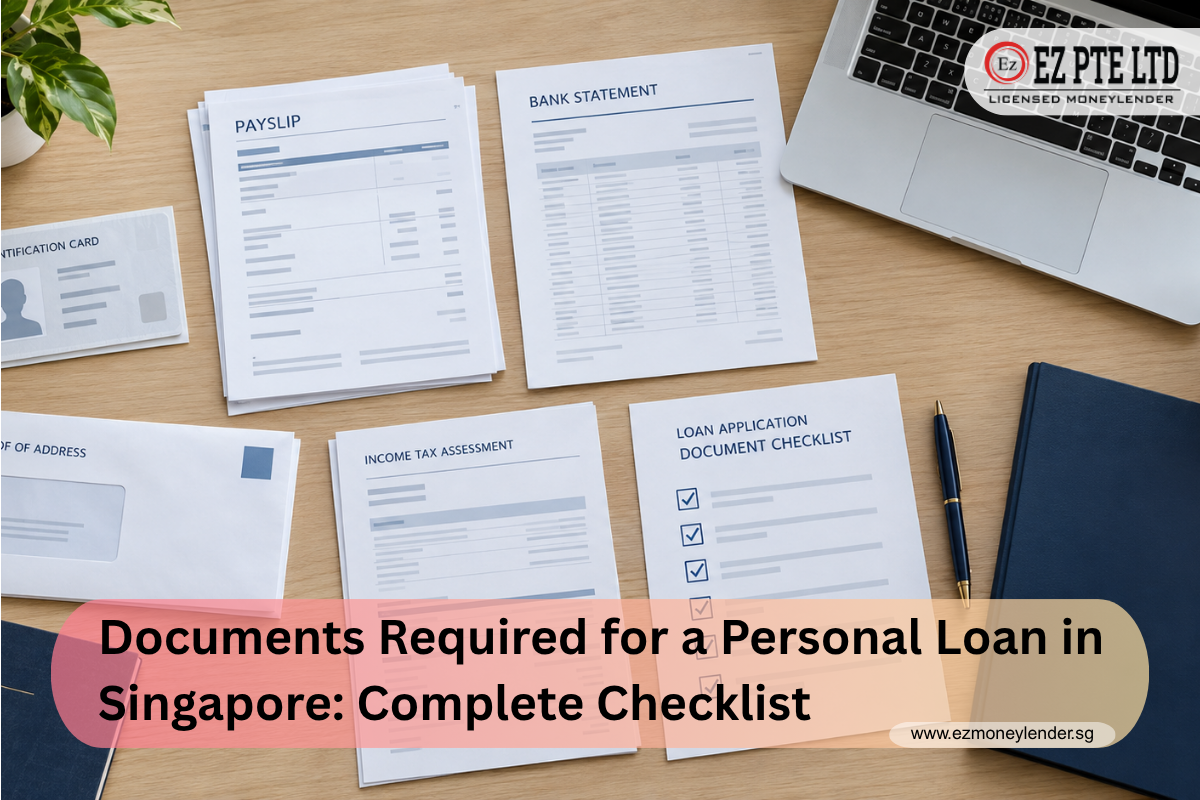
Depending on your residency and employment status, documents may include:
Singapore Citizens and Permanent Residents
- NRIC
- Proof of income
- CPF contribution information
- Income tax information
- Proof of residential address
Foreigners
Requirements may include:
- Passport
- Valid work pass
- Employment payslips
- Employment or appointment letter
- Bank statements showing salary credits
- Proof of residential address
Requirements can vary according to the application.
Can Singpass MyInfo Make a Loan Application Easier?
For eligible borrowers, Singpass MyInfo can simplify the application process by allowing verified personal information to be retrieved electronically.
This can reduce manual data entry and help ensure that the information submitted during an application is accurate.
However, an online application does not mean the entire licensed moneylender loan can legally be completed remotely.
Borrowers must still complete the required identity verification and loan-contract procedures in accordance with applicable regulations.
How to Compare Personal Loan Repayment Options
Do not compare loans based only on advertisements or headline rates.
Create a simple comparison:
| Loan A | Loan B | Loan C |
| Amount received | Amount received | Amount received |
| Interest rate | Interest rate | Interest rate |
| Repayment amount | Repayment amount | Repayment amount |
| Repayment frequency | Repayment frequency | Repayment frequency |
| Number of repayments | Number of repayments | Number of repayments |
| Applicable fees | Applicable fees | Applicable fees |
| Total payable | Total payable | Total payable |
Then ask yourself:
Which repayment arrangement can I realistically maintain without affecting essential expenses?
That question is often more useful than simply asking which lender offers the largest loan.
7 Personal Loan Repayment Mistakes to Avoid
1. Borrowing the Maximum Available
Borrow according to your actual need and repayment capacity rather than automatically taking the highest amount offered.
2. Looking Only at the Monthly Payment
Understand the total repayment obligation as well.
3. Ignoring Existing Debts
Existing financial commitments affect how much additional debt you can reasonably manage.
4. Not Reading the Contract
Understand the interest rate, repayment schedule, applicable fees and consequences of late repayment before signing.
5. Borrowing to Fund Non-Essential Spending
Consider whether borrowing is necessary and whether other alternatives are available.
6. Missing Payments Without Contacting the Lender
If you anticipate repayment difficulty, communicate early rather than ignoring the problem.
7. Borrowing From an Unlicensed Lender
Always verify a lender through the official Ministry of Law Registry of Moneylenders.
How to Identify a Licensed Moneylender in Singapore
Never assume a lender is legitimate simply because its website or WhatsApp profile looks professional.
Loan scams can misuse the names, logos and licence details of legitimate companies.
Before borrowing, verify the lender against the Ministry of Law’s official Registry of Moneylenders.
Be cautious if someone:
- Sends unsolicited loan advertisements through messaging apps
- Requests payment before loan disbursement
- Asks you to transfer money to obtain approval
- Requests your Singpass password or OTP
- Claims the entire loan can be completed without the required verification
- Pressures you to make an immediate payment
Verifying the lender before providing personal information can help protect you from loan scams.
Why Consider EZ Pte Ltd?
EZ Pte Ltd is a licensed moneylender in Singapore located at 150 South Bridge Road #01-02, Fook Hai Building, Singapore 058727.
The company has been operating since 2004 and provides several financing options for eligible borrowers, including personal loans, payday loans, foreigner loans, business loans, monthly instalment loans and debt consolidation loans.
Applications are assessed individually based on the applicant’s circumstances and ability to repay.
Borrowers should review the loan amount, interest, fees and repayment schedule carefully before accepting any offer.
Frequently Asked Questions About Personal Loan Repayment Singapore
How is personal loan repayment calculated in Singapore?
The repayment amount depends on factors including the principal borrowed, applicable interest, repayment schedule and permitted fees. Your lender should provide the repayment terms before you enter into the loan contract.
What is the maximum interest a licensed moneylender can charge?
The maximum interest rate permitted for licensed moneylenders is 4% per month. This is the legal maximum and does not mean every loan is necessarily charged at 4%.
How much can I borrow from a licensed moneylender?
The maximum unsecured amount depends on annual income and residency status. Singapore Citizens and PRs earning at least S$20,000 annually may borrow up to six times monthly income across licensed moneylenders, subject to assessment.
Should I borrow the maximum amount I qualify for?
Not necessarily. Borrow only what you need and can comfortably repay after accounting for essential living expenses and existing financial commitments.
Can I repay my EZ Pte Ltd loan early?
EZ Pte Ltd states that early repayment is permitted without an early settlement fee. Check your individual loan agreement and request the settlement amount before making an early repayment.
What happens if I miss a loan repayment?
Permitted late fees and late interest may apply. If you expect difficulty making a repayment, contact your lender promptly and review your contractual obligations.
Can I get a personal loan completely online?
You can begin parts of the application process online, but licensed moneylenders must comply with Singapore’s applicable identity verification and loan-contract requirements before disbursement.
How can I check whether a moneylender is licensed?
Check the lender’s details against the official list maintained by Singapore’s Ministry of Law Registry of Moneylenders rather than relying solely on advertisements, messages or social-media profiles.
Final Thoughts: Plan Your Personal Loan Repayment Before You Borrow
Understanding personal loan repayment Singapore requirements before borrowing can help you make a more responsible financial decision.
Don’t focus solely on how much you can borrow.
Instead, determine:
- How much you actually need
- How much you can afford to repay
- What interest applies
- What fees may apply
- How long repayment will take
- What the total repayment obligation is
A personal loan should address a financial need without creating an unmanageable repayment burden.
Before signing any loan agreement, make sure the repayment schedule is clear, ask questions about anything you do not understand and only proceed when you are comfortable with the terms.