Licensed Moneylender Interest Rate Singapore: Legal Fees and Loan Costs Explained
Before accepting a loan, it is important to understand more than the advertised monthly rate. The interest calculation, administrative fee, repayment schedule and potential late charges can all affect the total amount you may need to repay.
In Singapore, licensed moneylenders are regulated by the Ministry of Law. There are legal limits on the interest and fees that they may charge.
This guide explains the maximum licensed moneylender interest rate in Singapore, how reducing-balance interest works, which fees are permitted and what borrowers should check before signing a loan contract.
Key Takeaways
- A licensed moneylender may charge interest of up to 4% per month.
- The cap applies regardless of the borrower’s income or whether the loan is secured or unsecured.
- Regular interest must be calculated using the outstanding principal.
- The administrative fee cannot exceed 10% of the loan principal.
- A late fee cannot exceed S$60 for each month of late repayment.
- Late interest is limited to 4% per month on the overdue amount.
- Total interest and permitted fees cannot exceed an amount equal to the original principal.
- The legal maximum is not necessarily the rate every borrower will receive.
- Always compare the total repayment amount—not only the monthly interest rate.
What Is the Maximum Licensed Moneylender Interest Rate in Singapore?
A licensed moneylender in Singapore may charge interest of up to 4% per month.
According to the Registry of Moneylenders, this cap applies:
- To Singapore citizens
- To Permanent Residents
- To foreigners residing in Singapore
- Regardless of income
- To secured loans
- To unsecured loans
The 4% monthly rate is a legal maximum. It does not mean every applicant will automatically receive a 4% rate. The actual rate and repayment terms offered may depend on the assessment conducted by the lender.
The agreed interest rate must be clearly explained and stated in the Note of Contract before the borrower signs it.
Borrowers can review the latest rules in the Ministry of Law’s official guide to borrowing from licensed moneylenders.
How Is Licensed Moneylender Interest Calculated?
Regular loan interest must be calculated using the outstanding principal.
Outstanding principal means the portion of the original loan principal that has not yet been repaid. As principal repayments are made, the balance used for future interest calculations decreases.
Simple example
Suppose you take a loan with the following terms:
- Original principal: S$5,000
- Monthly interest rate: 4%
- Principal subsequently repaid: S$1,000
- Remaining principal: S$4,000
The next interest calculation should use the remaining S$4,000—not the original S$5,000.
At 4% per month:
| Outstanding principal | Interest at 4% for one month |
|---|---|
| S$5,000 | S$200 |
| S$4,000 | S$160 |
| S$3,000 | S$120 |
| S$2,000 | S$80 |
| S$1,000 | S$40 |
This is commonly described as a reducing-balance calculation because the interest amount reduces as the outstanding principal decreases.
The actual allocation of every repayment between principal and interest will depend on the signed repayment schedule.
Example of a Reducing-Balance Loan
The following simplified illustration assumes:
- Principal: S$5,000
- Interest: 4% per month
- S$1,000 of principal is repaid monthly
- No late payments
- Interest is calculated monthly
| Month | Starting principal | Monthly interest | Principal repayment |
|---|---|---|---|
| 1 | S$5,000 | S$200 | S$1,000 |
| 2 | S$4,000 | S$160 | S$1,000 |
| 3 | S$3,000 | S$120 | S$1,000 |
| 4 | S$2,000 | S$80 | S$1,000 |
| 5 | S$1,000 | S$40 | S$1,000 |
| Total | S$600 | S$5,000 |
The total illustrated regular interest is S$600.
This example does not include an administrative fee and is provided only to explain reducing-balance interest. It is not a loan quotation or an indication that an applicant will receive these terms.
You can use EZ Pte Ltd’s Singapore loan calculator to estimate monthly instalments and total repayment amounts.
Is 4% Per Month the Same as 48% Per Year?
Multiplying 4% by 12 gives a nominal figure of 48% over 12 months. However, that calculation may not represent the exact cost of a particular reducing-balance loan.
The actual cost depends on:
- The amount borrowed
- The offered interest rate
- Loan tenure
- Repayment frequency
- How quickly the principal decreases
- Administrative fee
- Whether repayments are made late
- Amounts and dates of principal repayments
If the outstanding principal decreases every month, the borrower is not necessarily paying 4% on the full original principal for all 12 months.
Instead of relying only on an annualised multiplication, examine the complete written repayment schedule and total amount payable.
For further explanation, read the guide to simple and effective interest rates.
What Fees Can a Licensed Moneylender Charge?
Licensed moneylenders are only permitted to impose specific charges and expenses.
1. Administrative fee
A licensed moneylender may charge an administrative fee of up to 10% of the loan principal when a loan is granted.
For example:
| Item | Amount |
|---|---|
| Approved principal | S$5,000 |
| Administrative fee at 10% | S$500 |
| Net amount received after deduction | S$4,500 |
Even though the borrower receives S$4,500 after the fee is deducted, the loan principal remains S$5,000.
Always confirm:
- The approved principal
- The exact administrative fee
- The net amount you will receive
- The total amount you must repay
2. Late-payment fee
A licensed moneylender may charge up to S$60 for each month of late repayment.
This is the maximum permitted fee. It does not mean that every late payment must automatically result in a S$60 charge.
The applicable late-payment terms should be disclosed in the contract.
3. Late interest
Late interest is capped at 4% per month.
Importantly, late interest may only be calculated using the amount that is overdue. It should not be charged on instalments that have not yet become payable.
4. Court-ordered legal costs
If a lender successfully pursues a recovery claim through the court, the borrower may be required to pay legal costs ordered by the court.
A lender cannot simply invent additional legal or recovery fees outside the applicable rules and court process.
How Does Late Interest Work?
Suppose a borrower has a monthly instalment of S$500 and fails to make that payment by the contractual due date.
At the maximum late-interest rate:
- Overdue instalment: S$500
- Late interest at 4% for one month: S$20
- Late fee: Up to S$60
| Item | Illustrative amount |
|---|---|
| Missed instalment | S$500 |
| One month of late interest | S$20 |
| Permitted monthly late fee | Up to S$60 |
| Total relating to that missed instalment | Up to S$580 |
Late interest should be calculated using the overdue S$500—not automatically on the entire outstanding loan if the other instalments are not yet due.
This is a simplified example. The actual amount will depend on the contract, payment date and overdue balance.
If you expect difficulty making a repayment, contact the lender before the due date. Early communication may help prevent the situation from becoming more difficult.
Is There a Maximum Total Charge?
Yes. The total charges imposed on a loan cannot exceed an amount equal to the original loan principal.
The charges included in this limit are:
- Regular interest
- Late interest
- Upfront administrative fee
- Late fees
For example, if the original principal is S$5,000, these combined charges cannot exceed S$5,000.
This does not mean the total amount repayable is limited to S$5,000. The principal must still be repaid.
In this example:
- Original principal: S$5,000
- Maximum combined interest and permitted fees: S$5,000
- Potential combined total: S$10,000
Court-ordered legal costs are treated separately.
This is a legal ceiling intended to protect borrowers—not a standard or target loan cost.
Principal, Interest and Fees Explained
| Term | Meaning |
|---|---|
| Principal | The original amount granted before interest and fees |
| Outstanding principal | The portion of the principal that has not been repaid |
| Regular interest | The cost of borrowing, calculated using the outstanding principal |
| Administrative fee | A one-time fee of up to 10% when the loan is granted |
| Late interest | Interest of up to 4% monthly on an overdue amount |
| Late fee | A fee of up to S$60 for each month of late repayment |
| Net disbursement | The amount received after an upfront fee is deducted |
| Total repayment | Principal, interest and applicable fees payable under the contract |
Do not confuse the principal with the net amount received.
Why the Total Repayment Is More Important Than the Advertised Rate
Two loan offers with the same monthly interest rate may have different total costs.
Differences can arise from:
- Loan tenure
- Repayment frequency
- Principal repayment amounts
- Administrative fee
- Repayment dates
- Late payments
- Early settlement arrangements
Before accepting a loan, request a written breakdown showing:
- Loan principal
- Administrative fee
- Net amount to be received
- Monthly interest rate
- Number of repayments
- Amount of every repayment
- Repayment dates
- Total regular interest
- Total repayment amount
- Late-payment consequences
- Early-settlement procedure
EZ Pte Ltd’s monthly instalment loan guide explains how a structured repayment schedule can help borrowers plan around fixed payment dates.
What Must Be Explained Before You Sign?
A licensed moneylender must explain the loan terms in a language the borrower understands.
Before signing, make sure you understand:
- The principal amount
- The amount you will receive
- The interest rate
- How the interest is calculated
- Administrative fee
- Repayment frequency
- Instalment amount
- Repayment dates
- Late interest
- Late-payment fee
- Total repayment amount
- Consequences of missing a repayment
- Early-settlement terms
Do not sign a blank or incomplete contract.
You should receive a copy of the completed loan contract and a receipt for each repayment. Keep your contract, receipts, account statements and final settlement confirmation.
Read EZ Pte Ltd’s official notes to borrowers before accepting any loan.
How to Compare Licensed Moneylender Loan Offers
Compare the same principal and tenure
A three-month loan and a 12-month loan should not be compared only by looking at the monthly instalment.
The longer loan may have a smaller monthly payment but a higher total interest cost.
Compare the net amount received
An administrative fee may be deducted when the loan is granted. Confirm how much money you will actually receive.
Compare the total amount repayable
Do not select a loan solely because it advertises a lower monthly rate. Examine the complete repayment amount.
Check affordability
After paying each instalment, you should still have sufficient funds for essential expenses such as:
- Housing
- Food
- Transport
- Utilities
- Medical expenses
- Insurance
- Dependants
- Existing commitments
Verify the lender
Check the company’s name, licence number and approved business address against the Ministry of Law’s official list.
Learn how to verify a licensed moneylender in Singapore before providing personal information.
Warning Signs of an Unlicensed Lender
A low advertised interest rate does not prove that a lender is legitimate.
Be cautious if someone:
- Sends an unsolicited loan advertisement through SMS, WhatsApp or social media
- Guarantees approval without assessing your income
- Requests an upfront payment before disbursement
- Asks for your Singpass password
- Requests access to your bank account
- Offers to grant and complete the loan entirely online
- Refuses to meet at an approved business address
- Asks you to sign blank documents
- Refuses to provide a complete repayment schedule
- Uses a licence number belonging to another company
A legitimate lender’s name, licence number and approved address should all match the official Registry of Moneylenders list.
Frequently Asked Questions
What is the highest interest rate a licensed moneylender can charge?
The maximum permitted regular interest rate is 4% per month. The cap applies regardless of income and whether the loan is secured or unsecured.
Does every moneylender charge 4% per month?
No. The 4% rate is the legal maximum. The actual rate offered may be lower and must be stated in the loan contract.
Is interest calculated using the original loan amount?
Regular interest must be calculated using the outstanding principal after applicable principal repayments have been deducted.
How much is the administrative fee?
The administrative fee may be up to 10% of the loan principal when the loan is granted.
How much is the late-payment fee?
A licensed moneylender may charge up to S$60 for each month of late repayment.
Can late interest be charged on the entire outstanding loan?
Late interest may only be charged on the amount that is overdue. It should not apply to future instalments that have not become due.
Can a lender charge both late interest and a late fee?
Both may apply if permitted under the contract. Late interest is capped at 4% per month on the overdue amount, while the monthly late fee is capped at S$60.
Can total interest and fees exceed the loan principal?
No. Regular interest, late interest, administrative fees and late fees combined cannot exceed an amount equal to the original principal.
Are online loan calculations final?
No. An online calculator provides an estimate. The final principal, interest, fees and repayment schedule are confirmed after assessment and must be stated in the contract.
How do I verify EZ Pte Ltd?
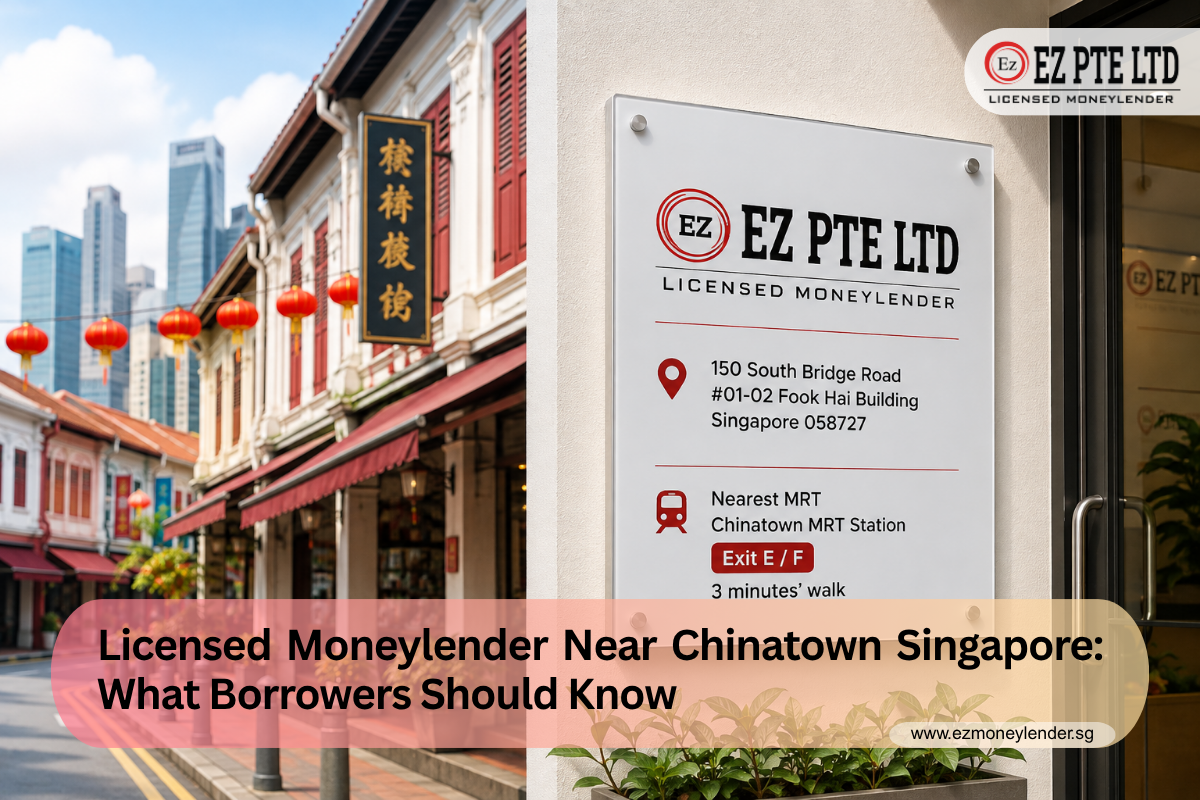
EZ Pte Ltd operates from 150 South Bridge Road, #01-02 Fook Hai Building, Singapore 058727. Verify the company name, licence number and approved address through the official Registry of Moneylenders before applying.
Final Thoughts
The maximum licensed moneylender interest rate in Singapore is 4% per month, but this figure alone does not reveal the complete cost of borrowing.
Before accepting a loan, review the principal, administrative fee, net amount received, repayment schedule and total amount payable. Confirm that the lender calculates regular interest using the outstanding principal and late interest only on overdue amounts.
Most importantly, choose a repayment schedule that remains affordable alongside your essential monthly expenses.
EZ Pte Ltd provides loan assessments from its Chinatown office and explains the applicable interest, permitted fees and repayment terms before the borrower signs the contract. Check your loan eligibility or contact EZ Pte Ltd if you need clarification.
This article is for general educational information and does not constitute financial advice. Loan applications are subject to assessment, document verification and approval.