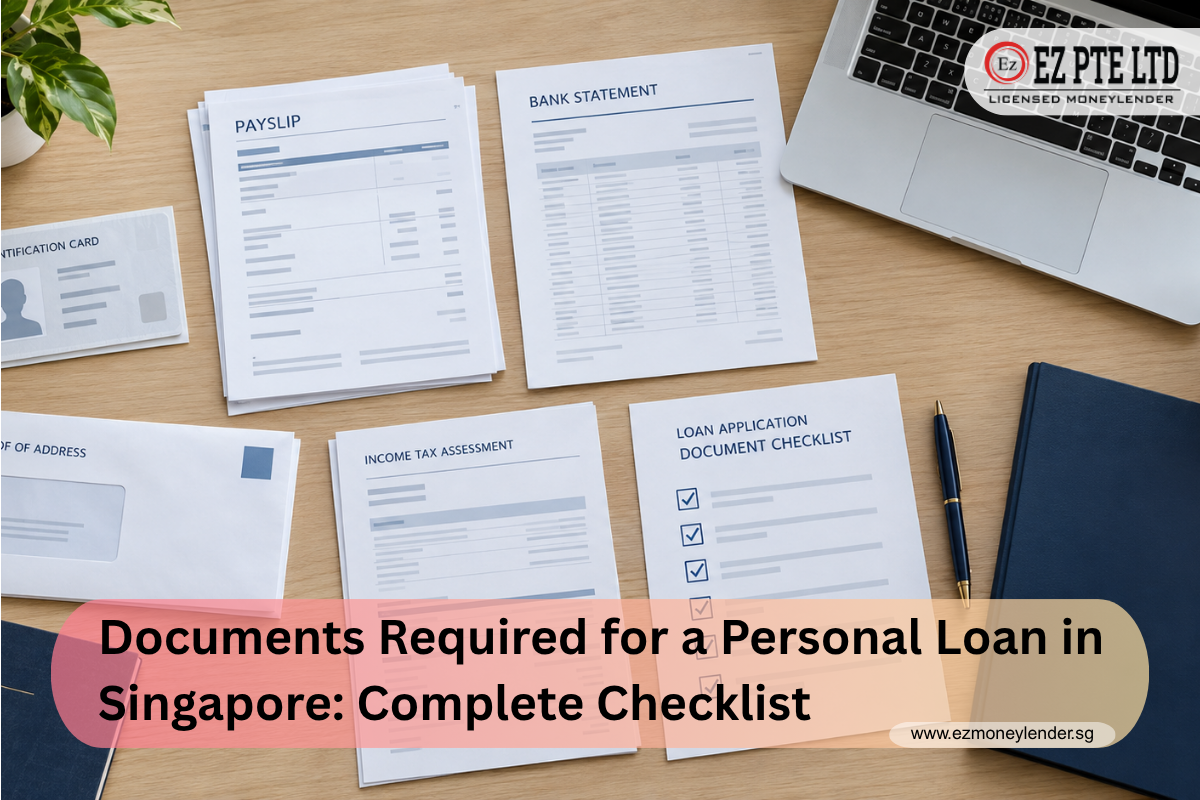
Documents Required for a Personal Loan in Singapore: Complete Checklist
Preparing the correct documents before applying for a personal loan can make your assessment clearer and more efficient.
However, the documents required for a personal loan in Singapore are not identical for everyone. A salaried Singapore citizen, self-employed applicant and foreign worker will each have different ways of proving their identity, income and residential address.
The licensed moneylender may also request additional information after reviewing your existing financial commitments and repayment ability.
This guide explains which documents Singapore citizens, Permanent Residents, foreigners and self-employed applicants should prepare when applying to a licensed moneylender.
Personal Loan Document Checklist at a Glance
| Applicant type | Main documents to prepare |
|---|---|
| Singapore citizen | NRIC, proof of address and proof of income |
| Permanent Resident | NRIC, proof of address and proof of income |
| Salaried employee | Recent payslips and CPF contribution history |
| Self-employed applicant | Income tax assessments, bank statements and relevant business records |
| Foreigner | Passport, valid work pass, proof of residence, payslips and bank statements |
| Commission or gig worker | Bank statements, platform earnings records, invoices or commission statements |
These are general document categories. The exact requirements may vary according to the applicant’s circumstances and the lender’s assessment.
Check EZ Pte Ltd’s current loan eligibility requirements before visiting the office.
Why Do Licensed Moneylenders Require Documents?
A licensed moneylender cannot responsibly grant a loan based only on an applicant’s verbal statement.
Documents help the lender verify:
- The applicant’s identity
- Singapore residential status
- Current employment
- Monthly or annual income
- Residential address
- Existing financial commitments
- Ability to manage the proposed repayment
- Whether the applicant is acting on their own behalf
Supporting documents also protect borrowers by ensuring that the loan offer is based on verified information rather than assumptions.
The Ministry of Law requires a licensed moneylender to meet the applicant at its approved place of business, conduct physical face-to-face identity verification and explain the loan terms in a language the applicant understands. Registry of Moneylenders guidance
Documents for Singapore Citizens and Permanent Residents
1. NRIC
Prepare your original NRIC for identity verification.
The lender may inspect your original identification document and retain an appropriate copy for its records. However, a licensed moneylender should not keep your physical NRIC after the verification process.
Check that the information submitted in your application matches your NRIC, including:
- Full name
- Identification number
- Date of birth
- Registered address, where applicable
Do not submit another person’s identification or allow someone else to apply using your details.
2. Proof of residential address
If your current residence differs from the address shown in available records, you may be asked for a recent document confirming where you live.
Accepted evidence may include:
- Utility bill
- Telecommunications bill
- Bank statement
- Tenancy agreement
- Official government correspondence
- Other recent documents showing your name and address
The document should be current, readable and issued in your name where possible.
If you are living with family and do not have a utility bill in your name, inform the lender rather than changing or fabricating a document.
3. Recent payslips
Salaried employees should generally prepare their recent payslips.
Payslips help confirm:
- Employer’s name
- Basic salary
- Allowances
- Overtime
- Commissions
- Deductions
- Net salary
- Payment period
EZ Pte Ltd’s current eligibility information recommends preparing the latest three months of payslips.
If your monthly income varies, several months of records provide a more accurate picture than one unusually high payslip.
4. CPF contribution history
CPF contribution records may help verify employment and salary consistency.
The lender may compare your CPF history with:
- Declared employer
- Payslips
- Salary deposits
- Length of employment
- Monthly income stated in the application
A recent job change or missing CPF contribution does not automatically mean that you cannot apply, but the lender may request other proof.
5. Bank statements
Bank statements help establish whether the declared salary is genuinely received.
The lender may check:
- Regular salary credits
- Name of the paying employer
- Average monthly income
- Existing loan deductions
- Recurring financial commitments
- Whether the account belongs to the applicant
Avoid submitting cropped screenshots that omit your name, statement period or transaction details. Complete statements are easier to verify.
Documents for Salaried Employees
A salaried applicant should prepare:
- NRIC or applicable identification
- Latest payslips
- CPF contribution records
- Bank statements showing salary credits
- Proof of residential address
- Employment letter if requested
Employment letter
An employment letter may be useful if:
- You recently started a new job
- Your first salary has not been credited
- Your payslip does not clearly show your employment status
- You receive a significant variable allowance
- You are employed on a contract
- Your employer’s name differs from the salary-crediting entity
The letter should ideally show your job title, commencement date, salary and employment status.
Personal Loan Documents for Self-Employed Applicants
Self-employed applicants may not receive conventional payslips or monthly employer CPF contributions.
Instead, they should provide documents that demonstrate actual and continuing income.
1. IRAS Notice of Assessment
An IRAS Notice of Assessment provides independent evidence of income declared for tax purposes.
EZ Pte Ltd’s eligibility page recommends that self-employed applicants prepare their recent income tax assessments.
An older assessment may not fully represent your current position. If your income has changed, provide newer records to support the difference.
2. Personal and business bank statements
Bank statements can show:
- Customer payments
- Business cash flow
- Regular owner withdrawals
- Operating expenses
- Available income
- Existing repayment commitments
Separating personal and business transactions usually makes the assessment clearer.
Gross business revenue should not automatically be treated as personal income. Rent, inventory, wages, transport and other operating expenses must also be considered.
3. ACRA business profile
A current ACRA business profile may help verify:
- Registered business name
- Business registration number
- Principal activities
- Business commencement date
- Ownership or directorship
- Registration status
An ACRA profile confirms that a business is registered, but it does not prove the applicant’s actual income by itself.
4. Invoices and payment records
Applicants earning project-based income may prepare:
- Recent invoices
- Customer contracts
- Payment receipts
- Commission statements
- Service agreements
- Online marketplace reports
Where possible, invoice amounts should correspond with deposits appearing in the bank statements.
5. Platform earning statements
Private-hire drivers, delivery riders and other platform workers may use official earning statements showing:
- Completed jobs
- Gross earnings
- Incentives
- Platform charges
- Weekly or monthly payouts
- Net earnings transferred
Use a reasonable period of records rather than only submitting your best-performing week.
Documents Required for Foreigners
Foreigners residing and working in Singapore may apply for an eligible personal loan, subject to assessment.
A foreign applicant should generally prepare the following.
1. Passport
Provide a valid passport for identity and nationality verification.
Ensure that:
- The passport has not expired
- The photograph is clear
- The name matches your work pass
- Your application uses the same spelling shown in the passport
2. Valid work pass
Depending on the applicant, this may include an:
- Employment Pass
- S Pass
- Work Permit
- Other valid pass allowing residence and employment in Singapore
The lender may check the type of pass, employer and expiry date.
An expired or soon-to-expire pass may affect the assessment because the proposed repayment schedule must be considered together with the applicant’s right to remain and work in Singapore.
3. Proof of Singapore residence
Foreign applicants should prepare evidence of their local address, such as:
- Tenancy agreement
- Utility bill
- Telecommunications bill
- Bank statement
- Official correspondence
If your accommodation is arranged by your employer, ask what alternative evidence can be accepted.
4. Recent payslips
Prepare recent payslips showing:
- Employer
- Salary period
- Basic salary
- Allowances
- Deductions
- Net salary
5. Bank statements
EZ Pte Ltd recommends that foreigners prepare recent bank statements showing their salary credits and financial activity.
6. Employment contract or confirmation
This may be requested when:
- Employment recently commenced
- Salary varies
- The applicant works under a fixed-term contract
- The employer shown on the payslip differs from the work pass
- Additional income clarification is needed
Read EZ Pte Ltd’s guide to foreigner loan documents in Singapore for more specific preparation advice.
Documents for Commission-Based and Gig Workers
Applicants with variable income should provide records covering a sufficient period to demonstrate a reliable pattern.
Useful documents include:
- Commission statements
- Platform earning reports
- Bank statements
- Invoices
- Customer contracts
- IRAS income assessments
- CPF or MediSave records, where applicable
The lender may calculate a reasonable monthly average rather than using the applicant’s highest-income month.
Example of average income
| Month | Verified income |
|---|---|
| January | S$2,800 |
| February | S$3,200 |
| March | S$2,600 |
| April | S$3,400 |
| May | S$2,900 |
| June | S$3,100 |
| Six-month average | S$3,000 |
This example is for illustration only. Actual assessment methods may differ.
Can Singpass MyInfo Replace Physical Documents?
Singpass MyInfo can simplify an application by securely providing available verified information after the user gives permission.
Depending on the information available, MyInfo may help retrieve:
- Identity details
- Residential information
- Employment-related records
- CPF information
- Income information
However, MyInfo may not contain everything needed for every applicant.
Additional documents may still be required when:
- You are self-employed
- Your income is commission-based
- You recently changed jobs
- Your registered address is outdated
- Your income has changed significantly
- You receive income from several sources
- Your employment records require clarification
- You are a foreigner with specific pass documentation
You can start through EZ Pte Ltd’s online loan application using Singpass MyInfo or the manual application option.
Never Share Your Singpass Password
Using Singpass MyInfo does not mean giving your password to the lender.
You should personally:
- Access the authorised Singpass login
- Review the information requested
- Authenticate the login yourself
- Approve or reject the data-sharing request
Never disclose your:
- Singpass password
- One-time password
- Banking password
- ATM PIN
- Email password
- Authentication code
A licensed moneylender should not ask you to reveal these credentials.
Can You Apply Without Payslips?
You may still be able to apply if you genuinely do not receive conventional payslips, but alternative income evidence will be required.
Examples include:
- Bank statements
- IRAS Notice of Assessment
- Commission statements
- Platform earning reports
- Employment letter
- Invoices
- Customer contracts
- ACRA business profile
The absence of a payslip is different from having no verifiable income.
Be cautious of anyone promising a guaranteed loan with no identification, income documents or assessment.
Can You Apply Without CPF Contributions?
Some applicants may have no recent employer CPF contributions because they are:
- Self-employed
- New to their job
- Foreign workers
- Commission-based workers
- Platform workers
- Receiving income through another legitimate arrangement
In these situations, the lender may request other documents showing genuine income and employment.
No single document guarantees approval. The lender will assess the applicant’s complete financial circumstances.
Why Might Documents Be Rejected?
The document has expired
An expired passport, work pass or old proof of address may no longer establish your current circumstances.
Information does not match
Differences in names, addresses, employers or income figures may require clarification.
Screenshots are incomplete
A cropped image may omit the account holder’s name, statement date or relevant transactions.
Income cannot be traced
Cash deposits without invoices, customer records or another explanation may not demonstrate stable earnings.
Documents appear altered
Never edit, recreate or manipulate a payslip, bank statement or official record.
The records are too old
Historical documents may not establish current income or employment.
Business and personal income are confused
Business turnover is not necessarily the owner’s disposable personal income.
How to Prepare Your Documents Properly
Before submitting your application:
- Check that every document is current
- Make sure names and identification numbers match
- Ensure scans or photographs are readable
- Include every page of a relevant statement
- Do not crop important details
- Use original downloaded statements where possible
- Arrange documents by identity, address and income
- Explain legitimate differences clearly
- Never change or fabricate information
Complete documents do not guarantee approval, but they allow the lender to assess your application more accurately.
Do You Still Need to Visit the Office?
Yes. Starting an application online does not remove the requirement for in-person verification before a licensed moneylender grants a loan.
The lender must meet the applicant at its approved business premises to:
- Verify identity against the original identification document
- Explain the loan terms
- Answer the borrower’s questions
- Complete the required contractual process
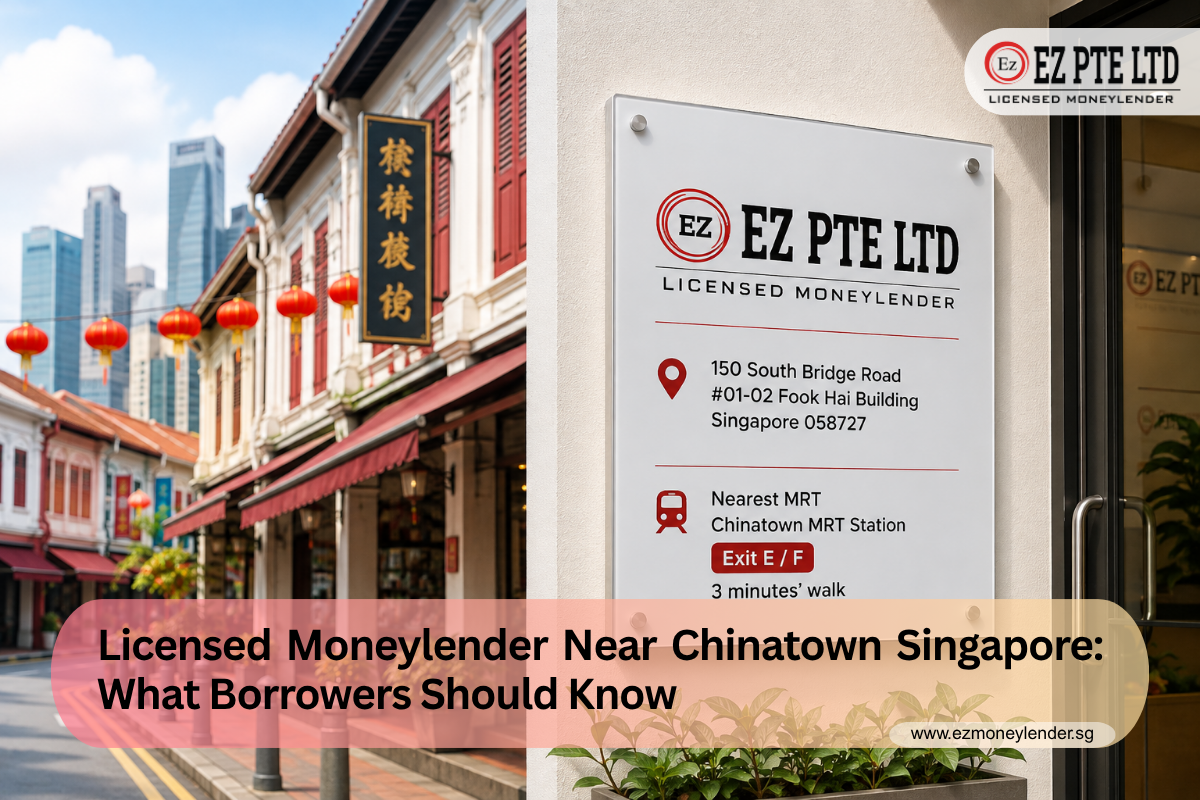
EZ Pte Ltd operates from:
150 South Bridge Road
#01-02 Fook Hai Building
Singapore 058727
The office is located near Chinatown MRT.
Learn what to expect during your first visit to a licensed moneylender.
Documents You Should Receive From the Lender
Loan documents are not only documents that the applicant submits. The borrower should also receive important records from the lender.
Copy of the completed loan application
Keep a copy of the application information submitted.
Note of Contract
The Note of Contract should contain the loan terms, including:
- Principal
- Interest rate
- Administrative fee
- Repayment schedule
- Instalment amounts
- Payment dates
- Late interest
- Late-payment fee
- Total repayment obligations
Do not sign a blank or incomplete contract.
Repayment schedule
Check every due date and repayment amount before accepting the loan.
Receipts
Obtain a receipt whenever a repayment is made and confirm that the amount and date are correct.
Statement of account
Keep statements of account provided during the loan tenure and check that repayments have been recorded accurately.
Loan-closure confirmation
After full settlement, request written confirmation that the loan has been paid and the account has been closed.
Questions to Ask Before Signing
Even when all documents are complete, do not sign until you understand:
- What is the principal?
- How much will I actually receive?
- How much is the administrative fee?
- What interest rate applies?
- How is interest calculated?
- What are my repayment dates?
- What is each instalment amount?
- What is the total repayment?
- What happens if I pay late?
- Can I settle early?
- Does the cooling-off period apply?
- Who should I contact if my income changes?
Use EZ Pte Ltd’s loan calculator to estimate repayments before making your decision.
Frequently Asked Questions
What are the main documents required for a personal loan in Singapore?
Applicants generally need identification, proof of residential address and proof of income. The exact records depend on employment and residency status.
How many months of payslips should I prepare?
EZ Pte Ltd’s current eligibility guidance recommends recent three months of payslips for employed applicants.
Do self-employed applicants need payslips?
Self-employed applicants may use tax assessments, bank statements, invoices and relevant business records instead of conventional payslips.
Can foreigners apply for a personal loan?
Foreigners residing and working legally in Singapore may apply with a valid passport, work pass, local address proof and income documents, subject to assessment.
Can I apply using Singpass MyInfo?
Yes. Singpass MyInfo may securely pre-fill available verified information, although additional documents may still be requested.
Must I give the lender my Singpass password?
No. Never give anyone your Singpass password or authentication codes.
Can a loan be approved entirely online?
An application may begin online, but a licensed moneylender must complete face-to-face identity verification and explain the terms at its approved business premises before granting the loan.
Will complete documents guarantee approval?
No. Approval depends on the complete assessment, including income, current commitments, borrowing limits and repayment ability.
Can the lender keep my NRIC or passport?
The lender may inspect the original document and keep an appropriate copy, but should not retain your physical NRIC, passport or work pass.
What documents should I receive after approval?
You should receive the completed contract and relevant repayment documentation. Keep all receipts, statements and final loan-closure confirmation.
Final Thoughts
Preparing the correct documents required for a personal loan in Singapore helps avoid unnecessary delays and gives the lender a clearer picture of your financial circumstances.
Singapore citizens and PRs should prepare their NRIC, address evidence and income records. Foreigners should also have their passport and valid work pass. Self-employed and gig workers can use tax assessments, bank statements, invoices and platform earning reports to establish income.
Using Singpass MyInfo may simplify the application, but additional documents can still be required.
Most importantly, submit accurate information, keep copies of everything and never sign an incomplete contract.
Review EZ Pte Ltd’s personal loan options, check your eligibility or contact EZ Pte Ltd if you need clarification about the documents relevant to your situation.
This article provides general information and does not guarantee loan approval. Every application is subject to assessment, verification and applicable regulatory requirements.