How Much Can I Borrow From a Licensed Moneylender in Singapore?
When an unexpected expense arises, one of the first questions you may ask is: How much can I borrow from a licensed moneylender?
In Singapore, a licensed moneylender cannot offer an unlimited loan simply because an applicant requests one. Statutory borrowing limits apply to unsecured loans, and your actual approved amount may be lower after your income, existing debts and repayment ability are assessed.
This guide explains Singapore’s licensed moneylender borrowing limits, how existing loans affect the amount available and what to consider before accepting an offer.
Key Takeaways
- Your maximum unsecured borrowing limit depends on your annual income and residency status.
- Singapore citizens and permanent residents earning below S$20,000 annually may borrow up to S$3,000.
- Foreigners earning below S$10,000 annually may borrow up to S$500.
- Applicants earning at least S$20,000 annually may borrow up to six times their monthly income.
- The limit applies across all licensed moneylenders combined.
- Reaching the legal limit does not guarantee that the full amount will be approved.
- Existing loans reduce the amount potentially available.
- Borrowing less than the maximum may produce a more manageable repayment plan.
Licensed Moneylender Borrowing Limits in Singapore
The maximum unsecured amount that an individual may borrow from licensed moneylenders is determined by annual income and residency status.
| Annual income | Singapore citizens and PRs | Foreigners residing in Singapore |
|---|---|---|
| Below S$10,000 | Up to S$3,000 | Up to S$500 |
| S$10,000 to below S$20,000 | Up to S$3,000 | Up to S$3,000 |
| S$20,000 and above | Up to 6× monthly income | Up to 6× monthly income |
These limits apply to your total unsecured borrowing across all licensed moneylenders, rather than separately to every lender.
The limits and other current borrowing rules can be checked in the Ministry of Law’s official guide for borrowers.
How Is the Six-Times-Monthly-Income Limit Calculated?
If your annual income is S$20,000 or more, your statutory unsecured borrowing limit can be up to six times your monthly income.
For example:
| Gross monthly income | Maximum statutory limit |
|---|---|
| S$2,000 | Up to S$12,000 |
| S$2,500 | Up to S$15,000 |
| S$3,000 | Up to S$18,000 |
| S$4,000 | Up to S$24,000 |
| S$5,000 | Up to S$30,000 |
These figures illustrate the legal ceiling. They are not guaranteed approval amounts.
A lender may approve less after examining your existing borrowing, living expenses, repayment record and other financial commitments.
Does the Limit Apply to Each Moneylender?
No. The unsecured borrowing limit applies across all licensed moneylenders combined.
Suppose your maximum limit is S$18,000 and you already owe S$11,000 to other licensed moneylenders. Your theoretical remaining capacity would be S$7,000.
However, this does not mean another S$7,000 must be approved. A lender may determine that a smaller loan—or no additional borrowing—is appropriate based on affordability.
Submitting applications to several companies does not multiply your legal borrowing limit.
How Do Existing Loans Affect the Amount Available?
Existing licensed-moneylender loans can reduce the amount you may be able to borrow.
A lender may review your records through the Moneylenders Credit Bureau to understand:
- Outstanding loan balances
- Active loan accounts
- Repayment history
- Late or missed payments
- Amounts already borrowed from other licensed moneylenders
- Whether another instalment would be manageable
Bank loans, credit-card balances and other commitments may also affect affordability, even if they are not calculated as part of the licensed-moneylender statutory limit.
Always disclose your current commitments accurately.
Why Might My Approved Amount Be Lower?
A statutory borrowing limit is the maximum potentially permitted by law. It is not an entitlement to receive that amount.
EZ Pte Ltd may consider several factors when assessing an application.
Verifiable income
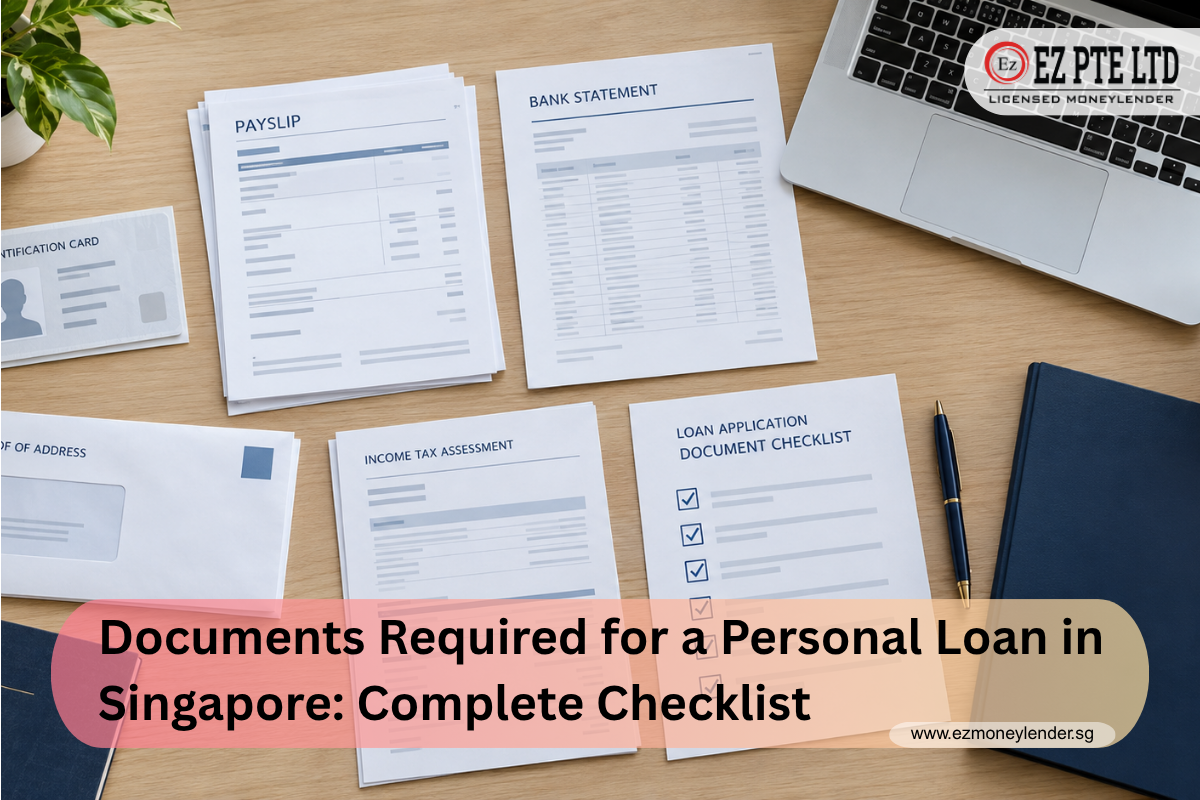
Your declared earnings should be supported by suitable records, such as payslips, CPF contribution history, bank statements or an IRAS Notice of Assessment.
Existing repayments
Even when you remain below the legal ceiling, existing monthly instalments may leave insufficient disposable income for another loan.
Employment stability
A stable income pattern may be easier to assess than irregular, recently started or undocumented earnings.
Self-employed and commission-based applicants may need to provide additional records covering a longer period.
Repayment history
Late payments, unsettled accounts or repeated repayment difficulties may affect the assessment.
Essential monthly expenses
Rent, utilities, transport, food, insurance and dependent-related costs must still be paid after a new instalment is added.
Requested repayment period
A shorter tenure may reduce the time during which interest accumulates, but it can produce larger instalments. A longer schedule may reduce each instalment but increase the total interest paid.
How Much Should You Borrow?
The amount you are legally allowed to borrow is not necessarily the amount you should borrow.
Start with the precise expense you need to cover. Then assess whether the repayment remains affordable after paying all essential costs.
A basic affordability calculation is:
Monthly income − essential expenses − current debt repayments = amount remaining before the new loan
Do not use the entire remaining amount for a new instalment. Leave a reasonable margin for unexpected costs or changes in income.
For example:
| Monthly budget | Amount |
|---|---|
| Take-home income | S$3,200 |
| Housing and utilities | −S$1,100 |
| Food and transport | −S$700 |
| Existing repayments | −S$450 |
| Insurance and family expenses | −S$350 |
| Remaining amount | S$600 |
An instalment close to S$600 would leave no emergency margin. A smaller loan or alternative arrangement may be safer.
Use EZ Pte Ltd’s loan calculator to estimate repayments before applying. Calculator results are illustrative and do not constitute an offer.
What Documents Help Establish Your Income?
The documents required depend on how you earn your income.
Salaried employees
Prepare:
- NRIC, passport or accepted identification
- Recent payslips
- CPF contribution history
- Recent bank statements
- Proof of residential address
- Employment details
Self-employed applicants
Useful records may include:
- IRAS Notices of Assessment
- Business bank statements
- Personal bank statements
- ACRA business profile
- Invoices and payment records
- Platform earnings statements
- Contracts or commission statements
Gross business revenue should not automatically be treated as personal income. Relevant operating expenses must also be considered.
Foreign applicants
Foreigners residing and working in Singapore may need:
- Passport
- Valid work pass
- Proof of address
- Payslips or income statements
- Bank statements
- Employment details
Review EZ Pte Ltd’s guide to foreigner loan documents before visiting the office.
Does a Higher Salary Guarantee a Larger Loan?
No.
A higher income may increase the statutory limit, but approval still depends on whether the proposed repayments are affordable.
For instance, two applicants earning S$4,000 per month may receive different assessments if:
- One has no outstanding debt while the other has several loans
- One has stable income while the other has recently changed employment
- One has lower essential expenses
- Their repayment records differ
- They request different loan amounts or tenures
The assessment should consider the applicant’s overall financial position, not income alone.
Can Someone With Bad Credit Still Apply?
A weak credit or repayment history does not automatically prevent an application, but it can affect the result.
The lender may approve:
- A lower principal
- A different repayment period
- A smaller instalment
- No additional loan if repayment appears unaffordable
Avoid applying to multiple lenders repeatedly in the hope of bypassing the assessment. Instead, review your outstanding balances and correct any inaccurate information in your records.
EZ Pte Ltd provides more information on its bad credit loan page.
What Interest and Fees May Apply?
Licensed moneylenders in Singapore may charge:
- Interest of up to 4% per month
- An administrative fee of up to 10% of the loan principal when the loan is granted
- Late interest of up to 4% per month on the overdue amount
- A late fee of up to S$60 for each month of late repayment
- Court-ordered legal costs arising from a successful recovery claim
Regular interest, late interest, administrative fees and late fees together cannot exceed an amount equivalent to the original loan principal.
Read EZ Pte Ltd’s guide to licensed moneylender interest rates and loan costs before comparing offers.
Example: Approved Principal Versus Amount Received
The approved principal and the amount disbursed may be different when an administrative fee is deducted.
For example:
| Item | Illustrative amount |
|---|---|
| Approved principal | S$5,000 |
| Administrative fee at 10% | −S$500 |
| Net amount received | S$4,500 |
The contractual principal remains S$5,000 even though the applicant receives S$4,500 after the fee.
Before signing, confirm:
- Approved principal
- Administrative fee
- Net disbursement
- Interest rate
- Instalment amount
- Number of instalments
- Total scheduled repayment
Can You Increase Your Borrowing Limit?
You cannot legally increase the statutory limit by applying through several licensed moneylenders.
Your available capacity may change if:
- Your verified income increases
- You repay an existing licensed-moneylender loan
- Your outstanding principal decreases
- Your financial commitments change
- Incorrect information in your borrowing record is corrected
Do not provide false income details or conceal existing loans. Any new assessment should use accurate, verifiable information.
Secured Versus Unsecured Borrowing Limits
The statutory table in this guide concerns unsecured loans.
An unsecured loan does not require the borrower to pledge an asset. Approval is generally assessed using income, existing commitments and repayment ability.
A secured loan is supported by an asset. Its structure and limit may differ, but the borrower risks losing the pledged asset if the contractual obligations are not met.
Most applicants seeking an everyday personal loan are considering unsecured borrowing. Learn more about unsecured loans in Singapore.
Questions to Ask Before Accepting an Offer
Before signing a loan contract, ask:
- What is the approved principal?
- How much money will I actually receive?
- What interest rate applies?
- How is the interest calculated?
- Is an administrative fee being deducted?
- How much is every instalment?
- When is each payment due?
- What is the total scheduled repayment?
- What happens if a payment is late?
- Can I comfortably manage the repayments alongside my existing expenses?
The terms should be explained in a language you understand. Do not sign a blank or incomplete contract.
How to Apply Safely
Check that the lender’s name and address appear on the Registry of Moneylenders’ official list before providing personal information.
Licensed moneylenders must conduct the required identity verification at their approved business premises before granting a loan. Be cautious if someone:
- Sends an unsolicited loan advertisement by SMS or WhatsApp
- Guarantees approval without an assessment
- Requests an upfront transfer before disbursement
- Asks for your Singpass password
- Offers to complete the entire process remotely
- Refuses to provide a completed contract
- Uses an address that differs from the official registry
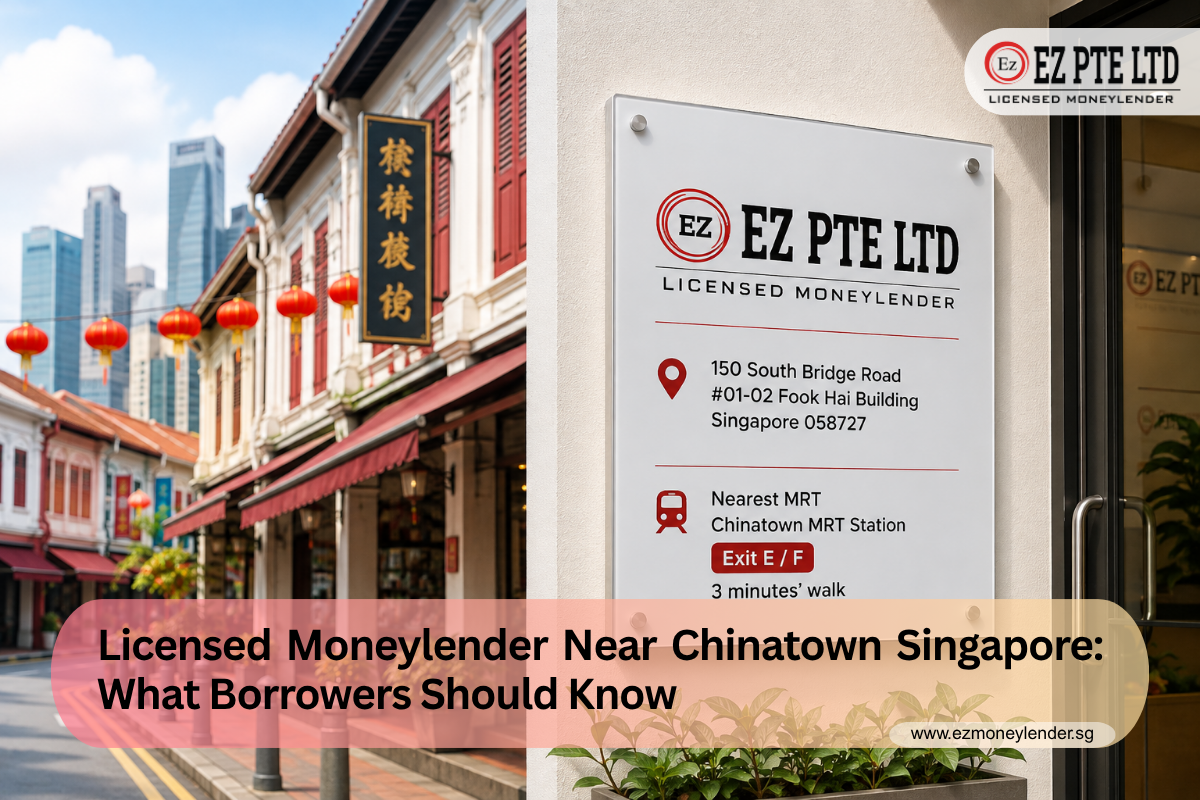
EZ Pte Ltd operates at 150 South Bridge Road, #01-02 Fook Hai Building, Singapore 058727, near Chinatown MRT. Verify current licensing information through the Registry of Moneylenders before applying.
Frequently Asked Questions
What is the maximum loan from a licensed moneylender?
Singapore citizens, permanent residents and foreigners earning at least S$20,000 annually may have a maximum unsecured borrowing limit of up to six times monthly income across all licensed moneylenders.
Lower limits apply to applicants earning below S$20,000.
Can I borrow six times my salary from every lender?
No. The limit is shared across all licensed moneylenders. Existing outstanding loans count towards it.
Can I obtain the maximum amount immediately?
Not necessarily. The lender must assess your income, expenses, current debts and repayment ability. The approved principal may be below the statutory maximum.
How much can a foreigner borrow?
A foreigner residing in Singapore may borrow up to S$500 when earning below S$10,000 annually, up to S$3,000 when earning from S$10,000 to below S$20,000, and up to six times monthly income when earning at least S$20,000 annually.
Do bank loans reduce my licensed moneylender limit?
The statutory licensed-moneylender limit relates to borrowing across licensed moneylenders. However, bank loans and credit-card repayments remain financial commitments and may reduce the amount considered affordable.
Can I apply if I already have another loan?
You may apply, but your existing balance reduces your available borrowing capacity and affects affordability. Approval is subject to assessment.
How can I check my estimated repayment?
Use EZ Pte Ltd’s online loan calculator to generate an illustrative estimate, then request a complete repayment schedule before accepting an offer.
Final Thoughts
The answer to “How much can I borrow from a licensed moneylender?” depends on your annual income, residency status and existing licensed-moneylender balances.
The statutory ceiling is only the starting point. Your approved amount should also reflect your income stability, essential expenses, existing repayments and ability to manage every instalment.
Check EZ Pte Ltd’s eligibility requirements, estimate repayments with the loan calculator or review the personal loan process before submitting an application.
This article is for general information and does not constitute financial advice. Loan applications remain subject to assessment, verification and approval.