Loan Tenure Singapore: How Long Should You Take to Repay a Loan?
Choosing the right loan amount is important, but choosing the right repayment period can be just as significant.
A shorter loan tenure may help reduce the period during which interest accumulates, but it normally creates higher instalments. A longer tenure can make each payment easier to manage, although the total borrowing cost may be higher.
The most suitable loan tenure in Singapore is not simply the shortest or longest option available. It is the shortest realistic period in which you can repay consistently without compromising essential household expenses.
This guide explains how loan tenure affects monthly repayments and total cost, how different loan structures compare and what borrowers should calculate before accepting an offer from a licensed moneylender.
Key Takeaways
- Loan tenure is the agreed period over which a loan will be repaid.
- A shorter tenure usually means higher instalments but potentially less total interest.
- A longer tenure usually lowers each instalment but may increase the total repayment.
- The lowest monthly payment is not necessarily the least expensive loan.
- The shortest repayment period is unsuitable if it creates an unaffordable instalment.
- Match the repayment period to your income cycle and the nature of your expense.
- Compare the principal, amount disbursed, instalments, fees and total repayment.
- Use conservative income figures if your earnings vary.
- Every repayment date and amount should appear clearly in your contract or repayment schedule.
What Is Loan Tenure?
Loan tenure is the period between receiving a loan and completing all scheduled repayments.
Depending on the loan structure, the tenure might be:
- Until your next salary date
- Several weeks
- Two or three months
- Six months
- Twelve months
- Another period agreed in the contract
The tenure affects:
- Number of repayments
- Instalment amount
- Repayment frequency
- Period during which interest accrues
- Total borrowing cost
- Length of your financial commitment
Do not choose a tenure by looking only at whether the monthly instalment appears low.
Shorter Versus Longer Loan Tenure
| Shorter tenure | Longer tenure |
|---|---|
| Higher repayment per instalment | Lower repayment per instalment |
| Principal reduces more quickly | Principal reduces more gradually |
| Interest may accrue for less time | Interest may accrue for longer |
| Shorter financial commitment | Longer financial commitment |
| Greater immediate cash-flow pressure | Lower immediate cash-flow pressure |
| Less flexibility during a weak-income month | More manageable scheduled payments |
Neither option is automatically better.
A short tenure can be cheaper but risky if the repayment consumes most of your next salary. A longer tenure may cost more but can be safer if the instalments remain manageable during an ordinary month.
How Does Tenure Affect Monthly Repayment?
Consider an illustrative S$3,000 loan.
The following simplified comparison assumes:
- Principal: S$3,000
- Interest: 4% per month
- Interest calculated using the outstanding principal
- Equal principal repayments
- No late payments
- Administrative fee excluded from the repayment table
| Tenure | Approximate principal paid monthly | Illustrative total interest |
|---|---|---|
| 3 months | S$1,000 | S$240 |
| 6 months | S$500 | S$420 |
| 12 months | S$250 | S$780 |
These examples are simplified illustrations rather than loan quotations.
They demonstrate the basic trade-off:
- A shorter tenure reduces the balance quickly but requires larger payments.
- A longer tenure reduces the monthly principal payment but keeps a balance outstanding for longer.
Your actual repayment schedule depends on the approved rate, payment frequency, principal allocation, fees and contract terms.
Use EZ Pte Ltd’s loan calculator to compare illustrative monthly payments before requesting a written quotation.
Why the Lowest Monthly Instalment Can Be Misleading
Suppose two offers cover the same principal:
- Offer A: S$800 per month for five months
- Offer B: S$450 per month for ten months
Offer B looks easier because the monthly amount is lower. However, you must compare:
- Total amount repaid
- Total interest
- Administrative fee
- Amount actually disbursed
- Number of months committed
- Effect of possible late payments
- Whether early repayment is permitted
A loan should never be selected using the monthly instalment alone.
Ask the lender to show you the complete repayment schedule and total amount payable if every instalment is paid on time.
Which Loan Tenure Fits Different Financial Needs?
The purpose of borrowing can help determine the appropriate repayment structure.
A gap before your next salary
If the expense is small and your upcoming salary can repay it comfortably after essential bills, a payday loan may match the timing.
A payday loan is designed for a temporary timing gap—not a continuing monthly shortfall.
Do not choose this structure if repaying the full amount from one salary would leave insufficient money for rent, food, transport or utilities.
An expense requiring a few months
A short-term loan may be more appropriate when one salary cannot comfortably clear the expense but repayment over several months is realistic.
Possible examples include:
- Essential vehicle repairs
- Rental deposits
- Urgent appliance replacement
- Temporary family expenses
- Uninsured medical costs
A larger personal expense
A monthly instalment loan spreads the repayment across scheduled monthly amounts.
This may suit expenses such as:
- Larger medical bills
- Planned household costs
- Education fees
- Necessary home repairs
- Several related expenses occurring together
The longer schedule should still be compared against its total cost.
General personal financing
A personal loan may cover different legitimate financial needs. Its tenure should reflect the amount borrowed, income frequency and affordable instalment.
Do not borrow for twelve months if you can comfortably clear the balance much sooner. Equally, do not select a very short period merely to reduce interest if the instalments are unrealistic.
Repeated or uncertain expenses
A line of credit differs from a single fixed loan because funds may be accessed according to the approved arrangement.
Before using a credit line, understand:
- Approved limit
- Amount drawn
- Interest calculation
- Minimum repayment
- Applicable fees
- How the facility is closed
A credit line should not become a permanent substitute for sufficient monthly income.
Business cash-flow timing
A business loan should be aligned with the business’s operating cycle rather than the owner’s personal salary date.
Consider:
- When customer invoices will be paid
- Inventory turnover
- Seasonal sales
- Rental and payroll dates
- Business expenses
- Whether incoming revenue is confirmed or only expected
A repayment due before the business generates revenue can create unnecessary cash-flow pressure.
Five Questions to Ask When Choosing a Loan Tenure
1. What can I afford during a normal month?
Start with reliable take-home income. Deduct essential expenses and existing commitments.
Essential expenses might include:
- Housing
- Food
- Utilities
- Transport
- Medical expenses
- Insurance
- Childcare
- Support for dependants
- Existing loan repayments
Do not use every remaining dollar for a loan instalment. Leave some buffer for unexpected expenses.
2. What happens during a weaker-income month?
Commission earners, freelancers, platform workers and business owners should calculate affordability using a weaker month rather than their highest earnings.
For example, if your monthly income ranges between S$2,500 and S$4,000, assess the repayment using approximately S$2,500—not S$4,000.
3. Is the financial need temporary or ongoing?
A loan can address a one-time expense. It does not solve a permanent gap where essential spending exceeds income every month.
If the shortfall repeats, taking another loan after every repayment may create a borrowing cycle.
4. How much will I repay in total?
Write down:
- Principal
- Administrative fee
- Net amount received
- Interest rate
- Instalment amount
- Number of instalments
- Total scheduled interest
- Total amount payable
If any number is unclear, ask for an explanation before signing.
5. Can I repay early?
Ask how early settlement works and request the process in writing.
Early repayment may reduce the period during which interest accrues. However, you should obtain an updated settlement figure rather than calculating the amount yourself.
EZ Pte Ltd states that it does not impose an early-settlement fee. The final settlement amount must still reflect the current account position.
How to Calculate an Affordable Instalment
Use this simple budgeting method:
Reliable monthly income − essential expenses − existing repayments − emergency buffer = potential repayment capacity
Example:
| Monthly budget | Amount |
|---|---|
| Take-home income | S$3,200 |
| Rent and utilities | −S$900 |
| Food and transport | −S$650 |
| Family and insurance commitments | −S$450 |
| Existing repayments | −S$300 |
| Emergency buffer | −S$300 |
| Remaining potential capacity | S$600 |
This does not mean the borrower should automatically commit the entire S$600.
A proposed instalment should leave sufficient room for expenses that vary between months.
Does a Longer Tenure Always Cost More?
Not necessarily in every contract, but a longer tenure commonly increases total interest because part of the principal remains outstanding for a longer period.
Total cost depends on:
- Approved interest rate
- Outstanding principal
- Repayment frequency
- Principal allocation
- Administrative fee
- Number of payments
- Late repayments
- Early settlement
This is why borrowers should compare written repayment schedules rather than rely on a general rule.
What Interest and Fees May Apply?
Licensed moneylenders in Singapore are subject to regulated limits.
The permitted charges include:
- Interest of up to 4% per month
- An administrative fee of up to 10% of the principal when the loan is granted
- Late interest of up to 4% per month on the overdue amount
- A late fee of up to S$60 for each month of late repayment
- Court-ordered legal costs for a successful recovery claim
Regular interest, late interest, administrative fees and late fees combined cannot exceed an amount equivalent to the original loan principal.
The maximum permitted rate is not necessarily the rate every borrower will receive.
How Repayment Frequency Affects the Decision
Tenure and repayment frequency are related but different.
A three-month loan could require:
- Weekly payments
- Fortnightly payments
- Monthly payments
- Another agreed schedule
Choose a repayment frequency that matches when you receive income.
| Income pattern | Potentially suitable repayment timing |
|---|---|
| Monthly salary | Monthly repayment after salary date |
| Fortnightly salary | Fortnightly or monthly schedule |
| Weekly platform income | Weekly or monthly schedule with sufficient buffer |
| Variable commission | Conservative monthly schedule based on average income |
| Business revenue | Schedule aligned with verified cash-flow cycle |
The specific arrangement remains subject to assessment and agreement.
Common Loan-Tenure Mistakes
Choosing the longest period only for a smaller instalment
A smaller monthly amount may feel comfortable but can result in a longer financial commitment and greater overall cost.
Choosing the shortest period only to save interest
Interest savings do not help if the repayment causes you to miss rent, utilities or another essential obligation.
Using future bonuses as guaranteed income
Bonuses, commissions and overtime payments may change. Build the repayment plan around reliable income.
Ignoring other repayment dates
Examine the combined effect of credit cards, bank loans, hire purchase and licensed-moneylender loans.
Borrowing more because the tenure is longer
A longer repayment period does not make unnecessary borrowing affordable.
Not checking the amount disbursed
An administrative fee may be deducted when the loan is granted. Confirm the principal and the amount that will actually reach you.
What Should Appear in Your Repayment Schedule?
Before signing, check that the documentation clearly shows:
- Loan principal
- Repayment dates
- Number of repayments
- Amount of each repayment
- Interest rate
- Applicable fees
- Total amount payable
- Consequences of late payment
- Early-settlement procedure
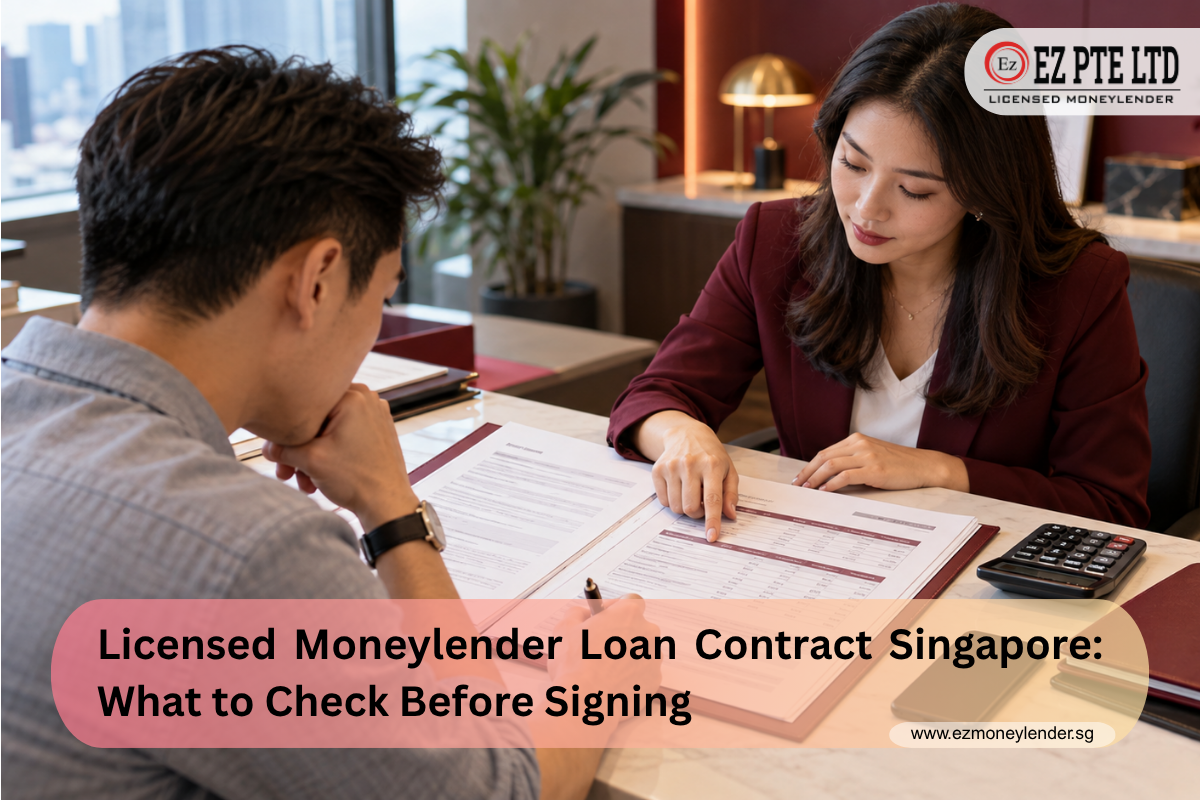
The Ministry of Law states that a moneylender must explain the loan terms in a language you understand and provide a copy of the loan contract.
Do not sign a blank or incomplete document.
When Should You Choose a Shorter Tenure?
A shorter tenure may be suitable when:
- Your income is stable
- The instalment remains affordable
- The expense is genuinely temporary
- You have sufficient emergency savings
- You want to minimise the borrowing period
- The repayment does not compromise essential costs
When Might a Longer Tenure Be More Practical?
A longer tenure may be considered when:
- A short schedule produces an unaffordable instalment
- Your income is stable but limited
- The expense is larger
- You need predictable monthly budgeting
- The total repayment remains acceptable
- You understand that interest may accrue for longer
Do not extend the tenure beyond what is reasonably needed simply to obtain the lowest displayed instalment.
Frequently Asked Questions
What is the best loan tenure in Singapore?
There is no single best tenure. The right period is the shortest realistic schedule with instalments you can pay consistently after covering essential expenses.
Is a shorter loan always cheaper?
A shorter tenure may reduce total interest because the principal is repaid more quickly. Actual cost depends on the contract, interest rate, fees and payment schedule.
Why does a longer tenure have a lower instalment?
The principal is divided across more repayment periods. This lowers each scheduled payment but keeps part of the balance outstanding for longer.
Can I choose my repayment period?
You may discuss your preferred tenure, but the final arrangement depends on assessment, loan type, amount, income and lender approval.
Can I change the tenure after signing?
The signed contract determines the repayment schedule. Any change requires the lender’s agreement and should be confirmed in writing.
Can I settle the loan early?
Ask the lender for an updated settlement amount and written instructions. Do not estimate the final balance yourself.
Is a payday loan better than an instalment loan?
A payday loan may fit a small timing gap that one upcoming salary can comfortably repay. An instalment loan may be more suitable when repayment needs to be spread across several months.
How can I compare two different tenures?
Compare the instalment amount, number of payments, total interest, administrative fee, net disbursement and total amount repayable.
Final Thoughts
Choosing the appropriate loan tenure in Singapore requires balancing monthly affordability against total borrowing cost.
A shorter tenure may reduce interest but create higher immediate repayments. A longer tenure can provide smaller instalments but may keep you in debt for longer and increase the total amount paid.
Before accepting any loan, calculate your reliable income, essential expenses, existing repayments and emergency buffer. Review the complete written repayment schedule—not only the advertised monthly amount.
EZ Pte Ltd is a licensed moneylender in Singapore located near Chinatown MRT. Borrowers can compare its payday loan, short-term loan, monthly instalment loan and personal loan information before deciding which repayment structure may suit their circumstances.
Every application is subject to assessment, verification and approval.
This article provides general educational information and does not constitute financial advice.